
Eastern Oregon residents call on Amazon to address air pollution before further data center development
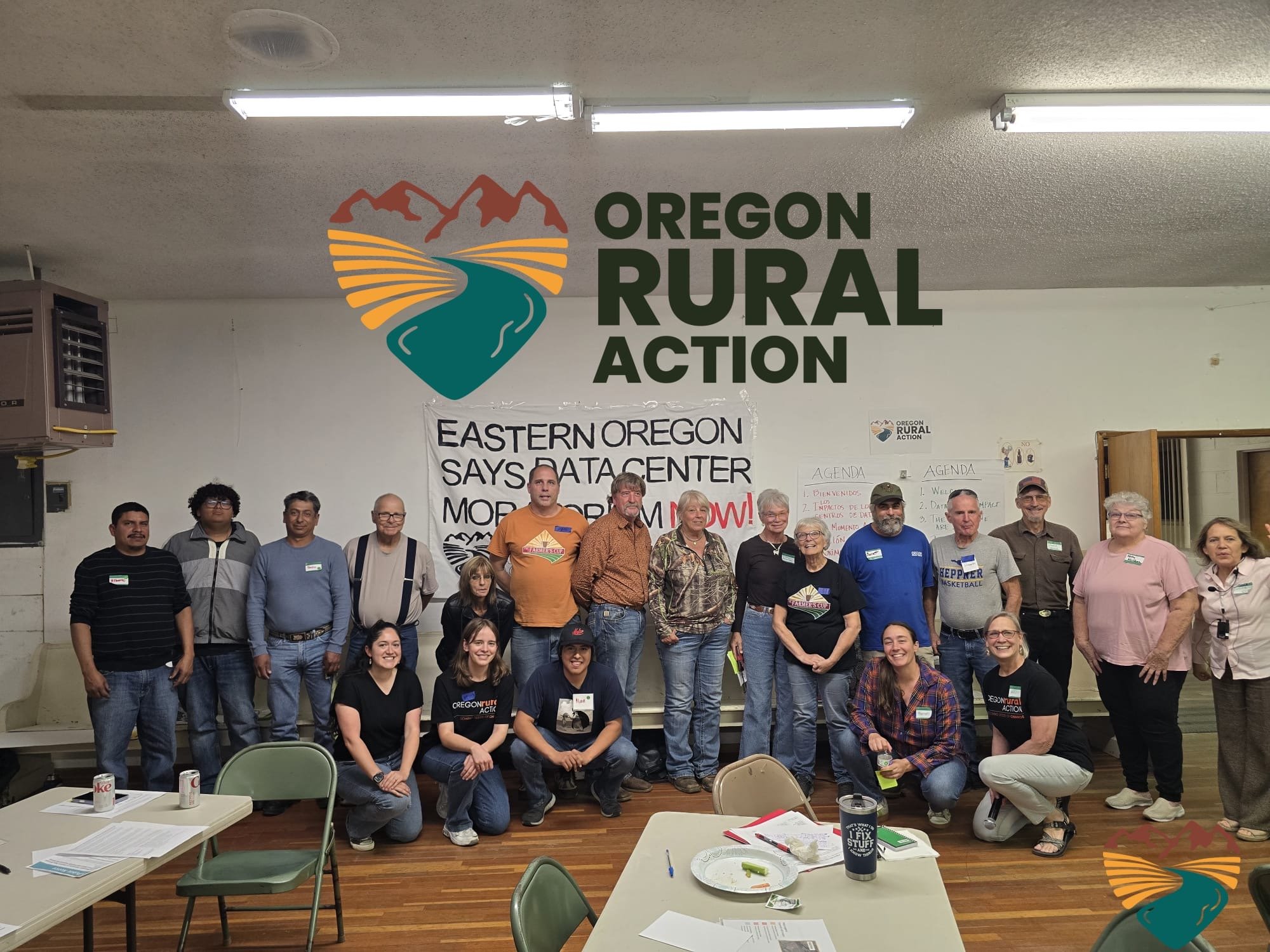
A group photo of community members after participating in a meeting to talk about Data Centers in Boardman, Ore.
Residents ask DEQ for a public hearing in eastern Oregon
HERMISTON – As artificial intelligence (AI) drives additional data center expansion in eastern Oregon, this week Oregon Rural Action (ORA) hosted the region’s first community meetings on data centers in Hermiston and Boardman.
People came to the meetings because of their concerns about existing data centers in the region–21 in various stages of development of which 19 are owned by Amazon Web Services. But most residents were unaware of the extent of the planned expansion in Morrow and Umatilla counties. They also voiced surprise at the big, long-term local tax breaks Amazon has already secured and frustration that city and county leaders have also quietly rezoned farmland for more data centers.
The Oregonian recently reported there are thousands of additional acres planned for data center development in Umatilla, Morrow, and neighboring Gilliam counties–7,073 according to data from the Oregon Department of Land Conservation and Development (DLCD). An additional 2,020 acres are slated for data center development in central Oregon.
With data center expansion, residents are concerned how data centers will impact the region’s ongoing drinking water crisis as well as their water use, air pollution, and loss of farmland. In the meetings residents noted their increasing electric rates and property taxes, while Morrow County gave Amazon a $1 billion in tax break for data centers over 15 years.
“We are very concerned about the cumulative impact of new data centers on air quality in the region due to existing pollution and frequent inversions,” said Kristin Anderson Ostrom, ORA’s executive director. “ From EPA data, it appears that 42% of all industrial air pollution in Oregon is already in Morrow and Umatilla counties. Do local officials and state regulators really think it is safe to add more?”
Air pollution was a primary, immediate concern for local residents attending this week’s public meetings where they discussed data center concerns and wrote public comments to the Oregon Department of Environmental (DEQ) about Amazon’s newest Boardman data center, PDX186. PDX186 would have 112 semitruck-sized diesel generators, which emit smog containing nitrous oxides (NOx), formaldehyde, benzene, and particulate matter, like what comes from wildfire smoke. These pollutants are known to cause asthma and cancer and increase the risk of heart and lung disease, according to the EPA.
“The decisions at the local level to approve data centers and give away millions and millions in tax breaks have been secretive because officials are signing NDAs,” said Barrett Dash, a farmer in Irrigon. “We want to know what’s going on locally, and we want a public hearing with DEQ to raise our concerns about air pollution and our health.”
Residents wrote comments in English and Spanish asking DEQ to hold an in-person, bilingual public hearing in the basin about the PDX 186 air quality permit.
Oregon Public Broadcasting recently reported an “outsized threat to Eastern Oregon’s air quality” and public health posed by the hundreds of backup diesel generators used by data centers in the region.
Air pollution would increase during a power outage as the backup generators are fired up. OPB estimates that a one-hour power outage in Morrow and Umatilla counties would force Amazon to run all its generators for an hour, it would create more diesel pollution than 38,000 semitrucks driving through town over the same period.
California and Washington require that data centers use “pollution controls” on generators, but Oregon does not. But in its PDX186 permit, Amazon proposes less than half of the backup generators at the new facility will have pollution controls.
“Since the technology exists to make these diesel generators cleaner, why wouldn’t Amazon choose to install it?” said Dawn Kennison-Kerrigan from Hermiston. “It would be a small step to protect our health, and they sure can’t claim they don’t have the money after all the tax breaks our commissioners have given them.”
In Oregon, the state air quality permits allow companies to pollute up to a certain threshold. In issuing permits, the State does not take into consideration pollution from other data centers or other industries that are also emitting into the same airspace or region.
“State regulators treat every data center as if its pollution exists in a vacuum,” said former Morrow County commissioner, Jim Doherty. “They completely ignore the cumulative impact. We have 21 data centers being stacked on top of existing industrial pollution, and the total toll on our community is simply not being considered.”
As the AI data center boom continues in eastern Oregon, residents say they want to protect their communities from future harm because of the cumulative impact and history of pollution. The region is downwind and downstream of the Hanford nuclear site; hosts dumps for northwest cities’ trash and sewage; and has the Umatilla Army Depot, where the US stockpiled munitions, mustard gas, and nerve gas. Up until 2011 when the Army Depot finished chemical disposal, residents practiced city-wide emergency drills in case of gas leaks. Residents are concerned this new industry will be another polluting industry.
“You can oppose data centers, or you can work at one and still have concerns about what this boom means for our counties,” said Doherty. “We need good jobs, but we also deserve clean air and water. We are coming together as a community to say we shouldn’t have to choose between the two.”
On September 8th Doherty and Dash joined neighbors at a rally at the State capitol in support of a statewide data center moratorium, which both gubernatorial candidates now support. Oregon Rural Action has collected over 700 petition signatures for a data center moratorium that would pause data center development until pollution, tax breaks, land use, and transparency are addressed.
“The data center issue has been immediately and deeply felt in our region,” said Anderson Ostrom of Oregon Rural Action. “Folks are already dealing with 40 years of industries polluting their drinking water with nitrate. This time they want state and local officials to do the only sensible thing–prevent pollution and the loss of health, life, and property that comes with it.”
###